Trig Review
The trig that you need to know for Calculus 1
Entering a Calculus 1 class, you may have one of several different backgrounds. Perhaps you've just taken a pre-calculus or trigonometry class and are very comfortable with the material. Maybe it's been years since you've even seen a trig function. Or, maybe it was confusing even at the time and you need a refresher. If you're looking for review, you've come to the right place. Feel free to skip around to the sections that you're most interested in, or read from start to end if you're so inclined. Let's start from the most fundamental aspect of trigonometry - angles.
Angles: Degrees and Radians
Most likely, you already have some idea of what an angle is. It gives us an idea of how different the direction between two things is. This is usually applied to lines. For example, the following two lines are going in similar directions, so the angle between them is small.

On the other hand, these two lines have a large angle between them.

Now, for each of the previous two examples I've shown two rays pointing in random directions. But if all we care about the angle, we can always rotate both rays so that one of them is horizontal. If we do that to the previous example, this will be the result:

So when we talk about angles, we can just move one of the rays, leaving the horizontal ray fixed. So, let's see what happens when we rotate one ray about its endpoint while we leave the other fixed.
We end up with a circle. Every point on this circle represents a unique angle between our two rays. It's not too important what the radius of the circle is, so we'll say that it's 1. In other words, we're looking at the unit circle. Let's take a look at the two units we typically use for angles.
Radians
As I mentioned a moment ago, each angle we can have between two rays can be represented by some point on the unit circle. When we do that, some portion of the circle's circumference will be between the two rays. For example, in the following image, one quarter of the circumference of the circle is between the two rays.

Remember that the unit circle has a circumference of since it has a radius of 1. So, one quarter of its circumference is . This is how we define radians. We say this is an angle of radians since that's how much of the circumference of the unit circle is between the two rays. In other words, radians tell you what portion of the circle's circumference is between the two rays. Here are some more examples.

Here we have one eighth of the circumference between the two rays, so the angle in radians is .

And in this example, five sixths of the circumference is between the two rays, meaning the angle is radians. Notice that we're measuring the angle by going counter-clockwise. The angle between the two rays if you travel clockwise is instead radians.
Degrees
Degrees are most likely the first way to measure angles that you've seen. The idea is actually really similar to the idea behind radians, but instead of using the circumference of the unit circle () as a base, we use 360 instead. So, a right angle is 90 degrees, or one quarter of 360, instead of radians, or one quarter of .
Intro to Trig Functions
Now that we've reviewed angles and how to measure them, let's talk about trig functions. The first place you'll usually see this is when talking about right triangles. So, let's look at one!
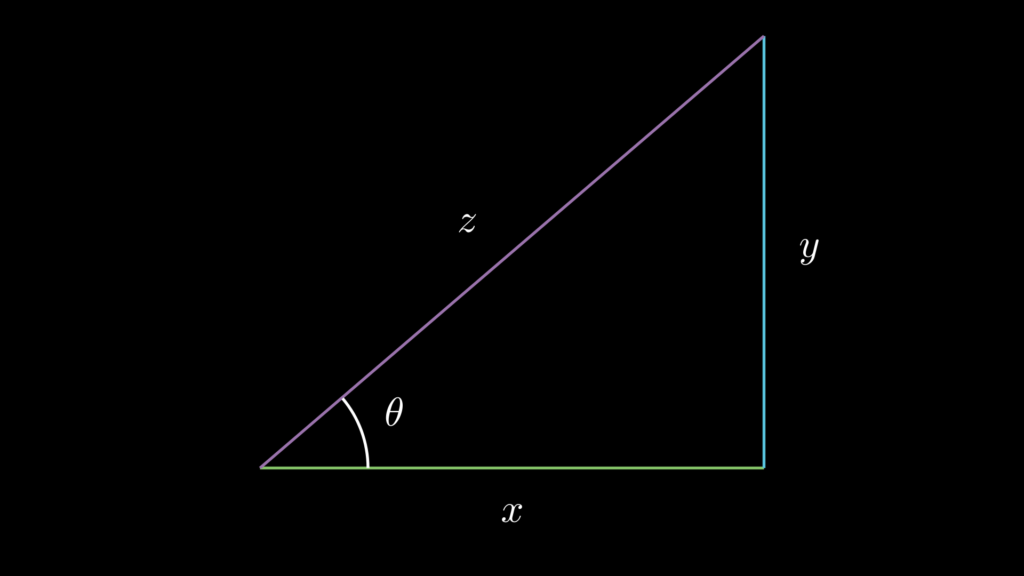
This is a right triangle with one angle being radians. Let's look at a specific ratio: the length of the side opposite of the angle divided by the length of the hypotenuse. This gives us . That's great and all, but what's so special about this? Well, consider what happens if we shrink the triangle down until the hypotenuse is just 1 unit long. From the Pythagorean theorem, we know that , so we must have . In other words, the other new side lengths are and .
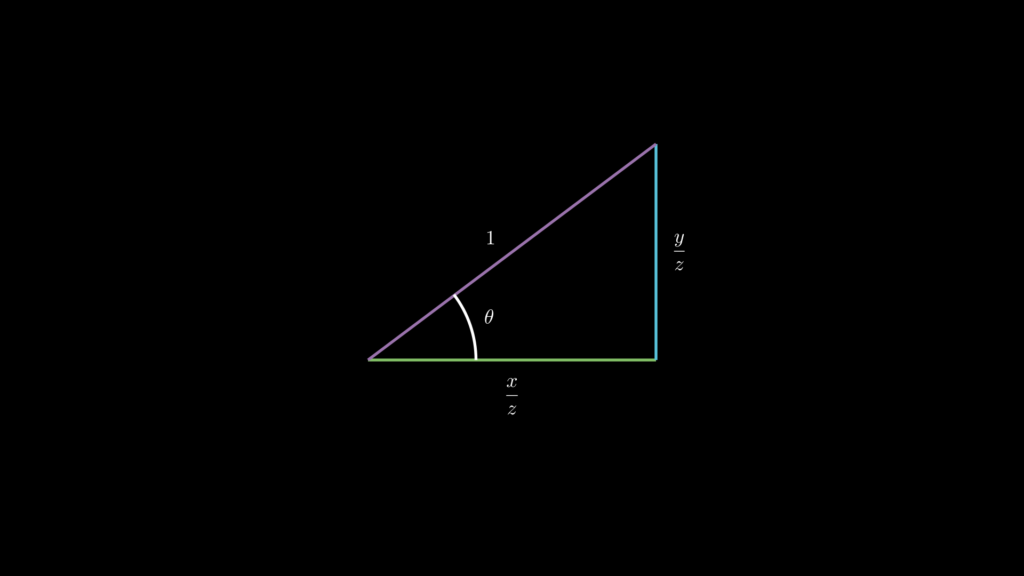
Let's look at that ratio from before again. Now, the length of the side opposite is , and the length of the hypotenuse is 1. So, that ratio is . That's the same answer we got for the bigger triangle! It turns out that no matter how big the triangle is, this ratio will always be the same as long as doesn't change. This leads to our first trig function, . You can find it by drawing any right triangle where one of the angles is radians, and then dividing the length of the side opposite by the length of the hypotenuse. In other words,
Note that it does matter whether you measure the angle in radians or degrees - the sine of 90 degrees will be different than the sine of 90 radians. That's why you sometimes need to switch between degrees and radians on your calculator.
You can do the same thing for other ratios of side lengths for triangles. If you divide the length of the side adjacent to by the length of the hypotenuse, you get a different function called . Similarly, dividing the length of the side opposite by the length of the side adjacent to gives you .
Lastly, you can also take the reciprocal of all of these ratios and get entirely different functions. These are sometimes called the reciprocal trig functions. They're called the secant, cosecant, and cotangent respectively.
You may have noticed something special when we were talking about the sine function: when the length of the hypotenuse was 1, was , which was just the length of the opposite side. In other words, when the hypotenuse has length 1, the length of the opposite side is actually just ! The same is true for cosine. When the hypotenuse has length 1, the length of the adjacent side is . Because of that, these trig functions are easiest to understand when the hypotenuse has length 1. This leads us back to the unit circle again. Let's look at an example.

Here, we draw a right triangle in the unit circle. We do this by drawing a line from the origin to the unit circle that makes an angle between the x-axis. This is the purple line, and has a length of 1 since it's a radius of the unit circle. Then, we draw a line straight down from the endpoint of the purple line to the x-axis. After this we end up with a right triangle.
As we saw earlier, for a triangle whose hypotenuse has length 1, the side lengths are actually just in the x direction and in the y direction! There are a few things we can take away from this.
- For any point on the unit circle, its coordinates are given by for some angle . The fact we only need one parameter, , to identify a point on a circle should make some sense: all we need to know is how far on the circle we've walked.
- Using the Pythagorean Theorem on this triangle, we know that . This ends up being true for any !
Now, you may remember that trig functions can be negative. Up until now, I've only been talking about trig functions as being positive lengths. But, let's look at what happens when our angle gets bigger.
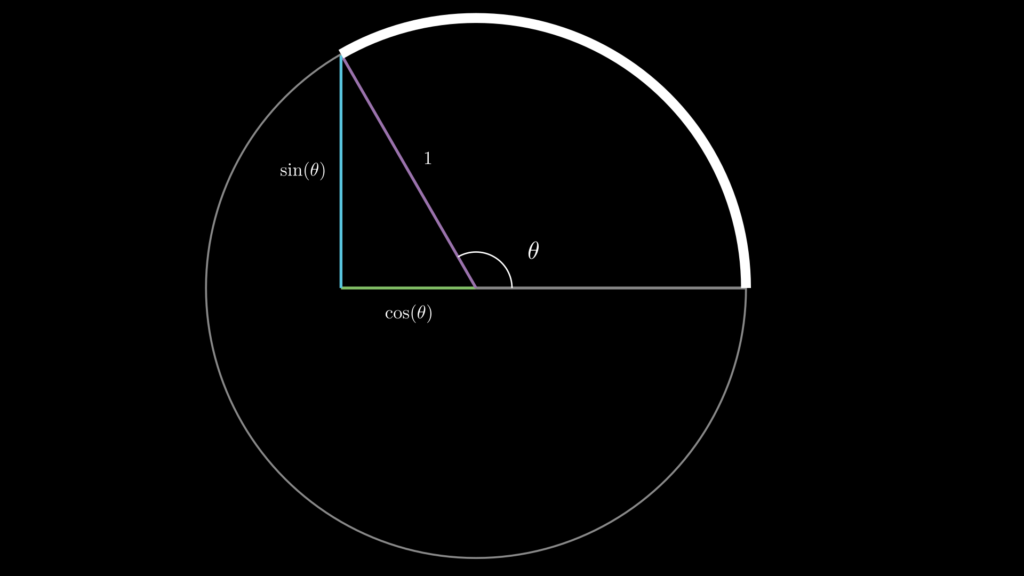
Well, now we've made our angle so big that we pushed the triangle over in the negative x direction. And even worse than that, isn't even an angle inside of the triangle anymore! Now it would be radians for that interior angle instead. If we want to talk about angles bigger than radians (or 90 degrees), this problem was inevitable - for a right triangle, neither of the other two angles can be greater than radians. But, if we keep leaning on this idea of being the height of this triangle and being the width, we can still work with this.
Earlier when I said that a point on the unit circle was given by , I was cheating a little bit. I hadn't made sense of these large angles yet. Let's say we still want that to be true. Well, the x-coordinate of the point on the unit circle in the image above is definitely negative, right? It's to the left of the origin. So, for this angle, should be negative too, since we want that to be the same as the x-coordinate of the point on the unit circle. The y-coordinate is still positive, so should also still be positive. Nothing changes there. Actually... let's notice something.